.svg)
Veylo is the AI-native modernization platform for mission-critical systems: it takes legacy applications from discovery through blueprinting, build, testing, data migration, and deployment in one governed environment — with your experts in control at every step. This post walks through the platform's twelve major functions: what each one does, the value it delivers, the ROI they add up to on a representative project, and the value that keeps working after the system ships.
Everything below is organized around one artifact. At the center of the platform is the Common Application Blueprint (CAB) — a structured, customer-owned source of truth for your application: user stories, workflows, business rules, roles, data, reports, integrations, permissions, and acceptance criteria. Discovery populates it, your experts validate it, and every other function reads from it and writes back to it. The modern system is generated from the Blueprint — which is why the value of each function flows into the next instead of getting lost in a handoff.
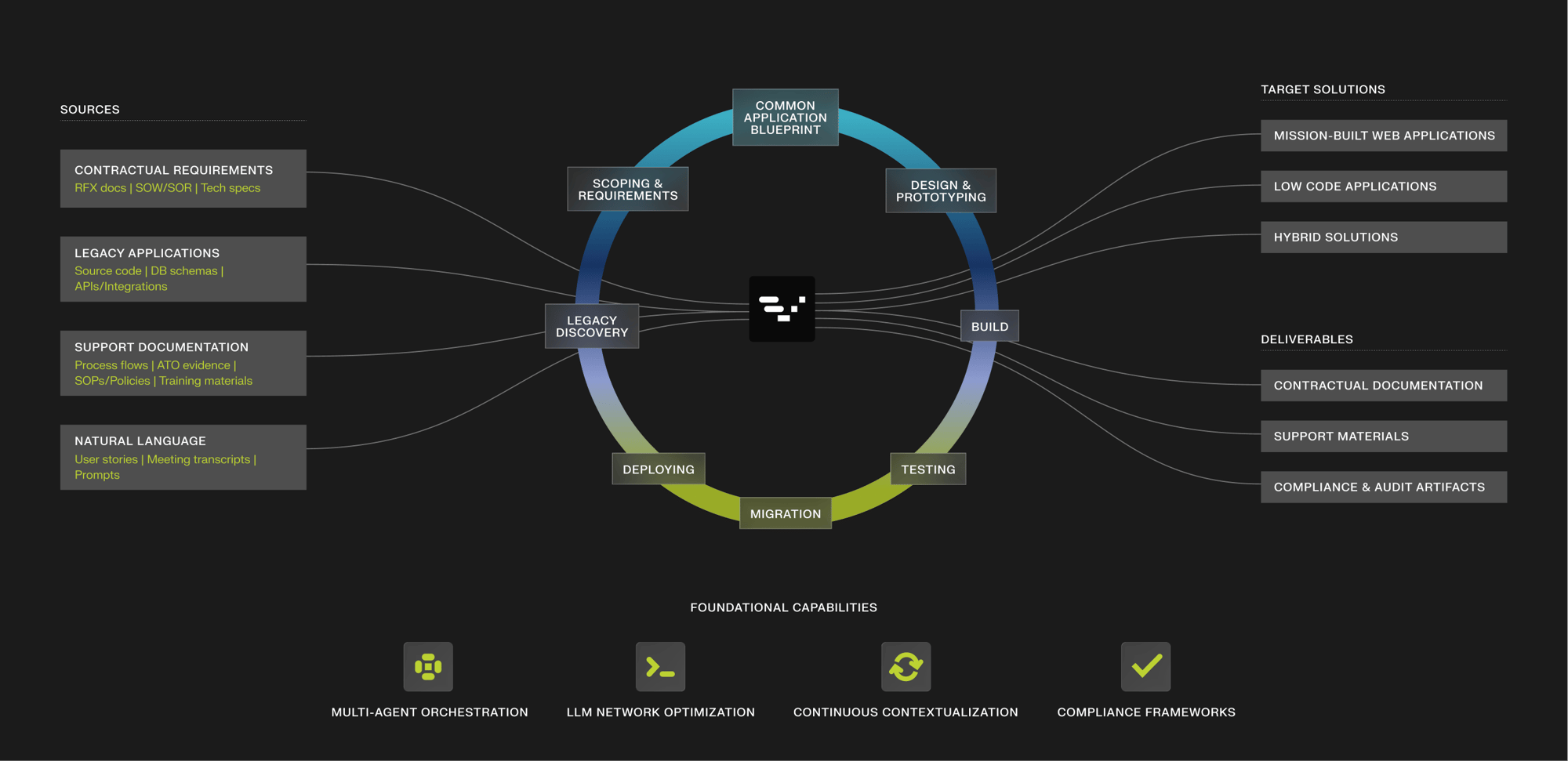
Understand and specify
1. Application discovery and legacy understanding
What it does: Ingests everything you have on a system — source code, database schemas, documents, user guides, screenshots, SME notes, and existing system artifacts — and builds a validated picture of the current state and the desired future state.
The value: Discovery compressed from months to days. Less dependency on tribal knowledge, lower risk of missed legacy functionality, and a structured current-state baseline you can use for planning and scoping.
2. Common Application Blueprint generation
What it does: Converts discovery into the structured Blueprint — stories, roles, workflows, data, business rules, reports, integrations, permissions, and acceptance criteria — reviewed and validated by your experts before anything is built.
The value: A single shared source of truth for the application, with traceability from source material to specification. The foundation for implementation planning, testing, documentation, and complexity-based scoping.
3. Blueprint elaboration and future-state design
What it does: Transforms legacy-state stories, workflows, and designs into future-state ones. When you refine a story, the platform automatically propagates the change to related design specs, workflows, data models, permissions, test scenarios, and downstream implementation artifacts.
The value: Requirements and technical design stay synchronized as the future state evolves — no manual rework, no drift, and a Blueprint that remains a living system of record instead of a static requirements document.
4. Implementation planning
What it does: Converts the Blueprint into an execution-ready implementation plan: delivery phases, sequencing, dependencies, work packages, technical tasks, acceptance criteria, and release planning.
The value: Closes the handoff gap between analysis, architecture, engineering, QA, and delivery management — and makes scope, sequencing, risk, and pricing assumptions transparent.
Build
5. Native web application generation
What it does: AI agents generate full-stack modern web applications — React front end, API layer, PostgreSQL backend, data models, forms, workflows, role-based experiences, dashboards, reports, permissions, and business logic — with build mode standing up the database and application servers.
The value: Working, reviewable software in a fraction of the traditional time, with repetitive engineering effort eliminated and every generated component traceable back to the Blueprint.
6. Low-code and platform modernization support
What it does: Translates the same Blueprint into platform-specific implementation artifacts, configuration guidance, data mappings, workflow definitions, and build tickets for Tyler/TAP, ServiceNow, Salesforce, Appian, Pega, Microsoft Power Apps, and others.
The value: Your target platform becomes a deployment decision, not a re-discovery project. One validated Blueprint drives custom or low-code delivery across your ecosystem.
7. Integration and API support
What it does: Defines APIs, integration points, data exchanges, authentication, error handling, and integration test scenarios alongside the build.
The value: Integration scope surfaces early — in the plan and the test coverage — instead of late, where it becomes a schedule crisis.
Prove
8. Testing and QA generation
What it does: Generates test cases, automated test scripts, UAT scripts, regression scenarios, workflow paths, and role-based tests from the Blueprint and the application logic — with requirement-to-test traceability.
The value: Provable coverage, dramatically less manual QA preparation, lower UAT risk — and the requirement-to-test evidence that acceptance, IV&V, and oversight bodies ask for.
9. Test execution and feedback loop
What it does: Runs the generated test scripts, captures errors and failures, feeds defects back to the builder agents, re-validates corrected functionality, and documents successful completion.
The value: A closed build-test-fix loop that replaces the largest share of traditional delivery labor — and produces documented go-live confidence.
10. Data migration support
What it does: Maps, transforms, validates, and reconciles legacy data into the target application or platform — demonstrated on a statewide deployment including full legacy data migration.
The value: The highest-risk part of modernization, de-risked: data reconciled against the future-state model means go-live readiness you can show, not hope for.
Deliver and sustain
11. Documentation generation
What it does: Produces user guides, admin guides, technical documentation, data dictionaries, release notes, training materials, and compliance-supporting documentation — kept aligned with the evolving Blueprint and the generated application.
The value: No closing documentation scramble. Docs that stay true instead of going stale, because they're generated from the same source of record as the system itself.
12. Deployment, DevSecOps, and environment support
What it does: Supports deployment patterns across commercial cloud, GovCloud, private cloud, on-premises, and containers — with CI/CD, Git-based workflows, and environment management.
The value: The system ships where your mission lives — your environment, your source code, no lock-in — with the operational foundation for everything after go-live.
The ROI
On a representative modernization, the practical estimate: Veylo saves roughly $2.4M–$3.3M in direct labor cost, with a midpoint around $2.8M — assuming a blended fully loaded delivery cost of $125–$175/hour across business analysts, architects, developers, QA, project management, migration resources, and related delivery roles.
Direct labor dollar savings
Scenario range
These figures are model-based estimates for a representative project and cover direct implementation labor only. They exclude additional value from faster time-to-mission, lower rework, reduced program risk, and earlier benefit realization. Results vary with scope and complexity — and because complexity at Veylo is measured from your Blueprint, you'll see your own numbers before you commit.
The value that continues after go-live
The initial modernization creates the application and its Blueprint. The subscription keeps both alive. As requirements, workflows, data models, roles, and rules change, the Blueprint stays synchronized with the running application — and the same twelve functions keep working:
- Enhancements generate from the maintained Blueprint — new modules, workflow changes, forms, and reports, with change-impact analysis before you build.
- Tests regenerate and re-run with every change, protecting existing workflows, permissions, reports, and integrations from regressions.
- Documentation stays current — user guides, admin guides, release notes, data dictionaries, and training materials update with the system.
- Traceability persists from source requirement through design, code, tests, deployment, and change history — permanent auditability, on demand.
Your system never drifts back into undocumented legacy, and the understanding you paid for in discovery keeps paying you back with every change.
See it on your own system
Bring us one application. Discovery produces its Blueprint; the Blueprint produces a validated picture of what you own, a scoped plan, and your own version of the ROI model above — before you commit to anything.
Request a demo, or explore the platform in depth on the Platform page.